

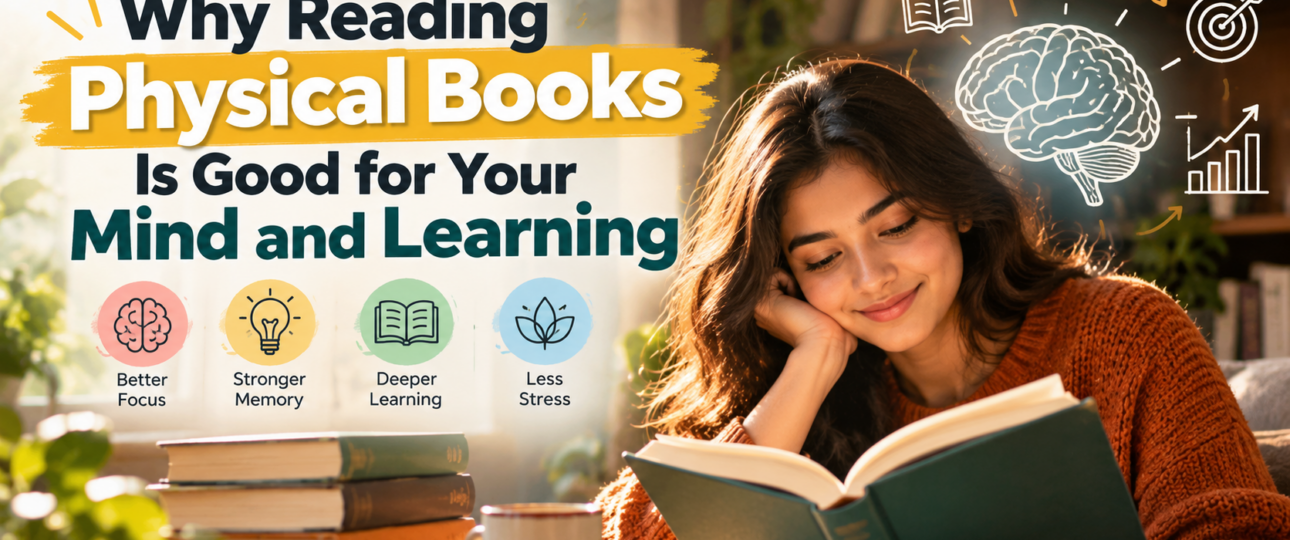
Most of us spend the day staring at glass. We glance at messages while working, read articles between tasks, and check our feeds before sleeping. It feels like we take in plenty of information. Yet at the end of the day, very little of it sticks. Something changes when the screen turns off and you pick up something real.
Why Your Brain Loves Paper Books

When you hold a book, your hands and eyes work together to build a map of the text. You know right away where a sentence sits on the page, whether it was near the top corner or along the bottom edge. You also feel the thickness of the left side growing heavier as you make progress.
A screen cannot do this. Digital text slides past on an endless scroll, so the brain loses its place. When you read a paperback book, the physical shape gives your mind concrete anchors. That physical layout makes it much easier to track arguments and follow a story without getting lost.
Physical Books Help You Remember More
Memory depends on focus and location. When information sits in one fixed spot on a page, your mind files it away with less effort. A large 2018 review by Delgado and other researchers looked at roughly 171,000 readers across dozens of studies. They found that people who read from paper had better comprehension on average than those reading on screens.
The gap is not massive, but it shows up consistently when people read non-fiction, textbook chapters, or anything under a time limit. For light stories, the format makes little difference. But when the material gets tough, a paperback book gives your mind the stability it needs to retain the facts.
Better Learning for Students
Studying demands serious mental effort, and paper helps keep that effort on track. Students who learn from physical sheets tend to absorb the main ideas faster because they do not have to fight the constant pull of the internet.
- Fewer background distractions: There are no open tabs, notifications, or battery alerts pulling at your attention.
- Easy visual marks: Writing in margins, folding a corner, or underlining text creates physical landmarks that make reviewing faster.
- Honest self-checks: On a device, students often skim and assume they understand the topic. Turning actual pages slows them down enough to realize when they missed a point.
Screens Make You Skim, Books Make You Think

Devices train our eyes to scan in an F-shaped pattern. We jump across the first line, drop down the left margin, glance at subheadings, and pick out keywords. That habit is great for finding a quick answer online, but it ruins deep thinking.
Reading on paper breaks that skimming habit. You cannot click a word to see something else, and you cannot swipe away when a paragraph gets dense. You simply have to sit with the thought until it makes sense.
Reading Paper Reduces Stress and Eye Strain
A 2009 study from the University of Sussex showed that reading quietly for just 6 minutes cut stress levels by around 68 percent. That test checked reading in general, but paper adds an extra layer of rest because it gives your eyes a true break from glowing glass.
| Feature | Paper Books | E-Ink Readers | Tablets and Phones |
| Light Source | Relies on room light | Front-lit or reflective | Harsh backlight |
| Eye Fatigue | Very low | Low | High during long sessions |
| Sleep Impact | None | Low | Blue light disrupts melatonin |
| Distraction Level | None | Almost none | Constant notifications |
Sitting with a paperback book before bed lets your nervous system settle down naturally, without blue light tricking your brain into thinking it is still noon.
How Physical Books Build Longer Attention Spans
Modern attention spans are splintered. Switching between apps every few minutes trains your brain to expect a fresh reward every few seconds.
Reading physical pages trains the exact opposite muscle. When you read a chapter, you follow a single line of thought across multiple pages. Over time, spending an uninterrupted hour with a paperback book rebuilds your ability to concentrate on one task without fidgeting or reaching for your phone.
The Emotional Pull of a Real Book
There is a tactile comfort to physical reading that code on a screen cannot copy. The weight of the spine, the texture of the paper, and the smell of the ink all ground you in the moment.
People often keep a paperback book on a shelf for years after finishing it. Walking past it brings back the exact place, season, and mood you were in when you read those pages. Digital files simply sit hidden inside a folder, easy to buy and just as easy to forget.
Print Books vs E-Readers: What Research Says
Screens are not bad for everything. Digital readers win easily when you need to carry twenty titles on a trip, look up definitions on the spot, or enlarge tiny text. Research also shows that people who read on screens constantly can narrow the comprehension gap through habit and practice.
Even so, the fundamental difference remains. For fast lookups and casual browsing, digital tools work fine. But for deep study, sustained focus, and lasting memory, paper still holds the edge.
Conclusion
Carrying thousands of titles on a thin piece of glass is undeniably convenient. Yet our minds did not evolve for endless scrolling and flickering pixels. The next time you want to learn something difficult or just give your mind a quiet break, step away from the chargers. Pick up a paperback book, sit in a quiet chair, and let your brain do what it was meant to do.
Nexus-Stories has books in different languages at great prices. Check out free sample pages before you order physical books.